Calebonne Score
Universal, category-relative, deterministic. A 0–100 rating of a packaged food or personal-care product against realistic alternatives in its own category, computed by a fixed set of published rules from the label.
Product intelligence for the aisle
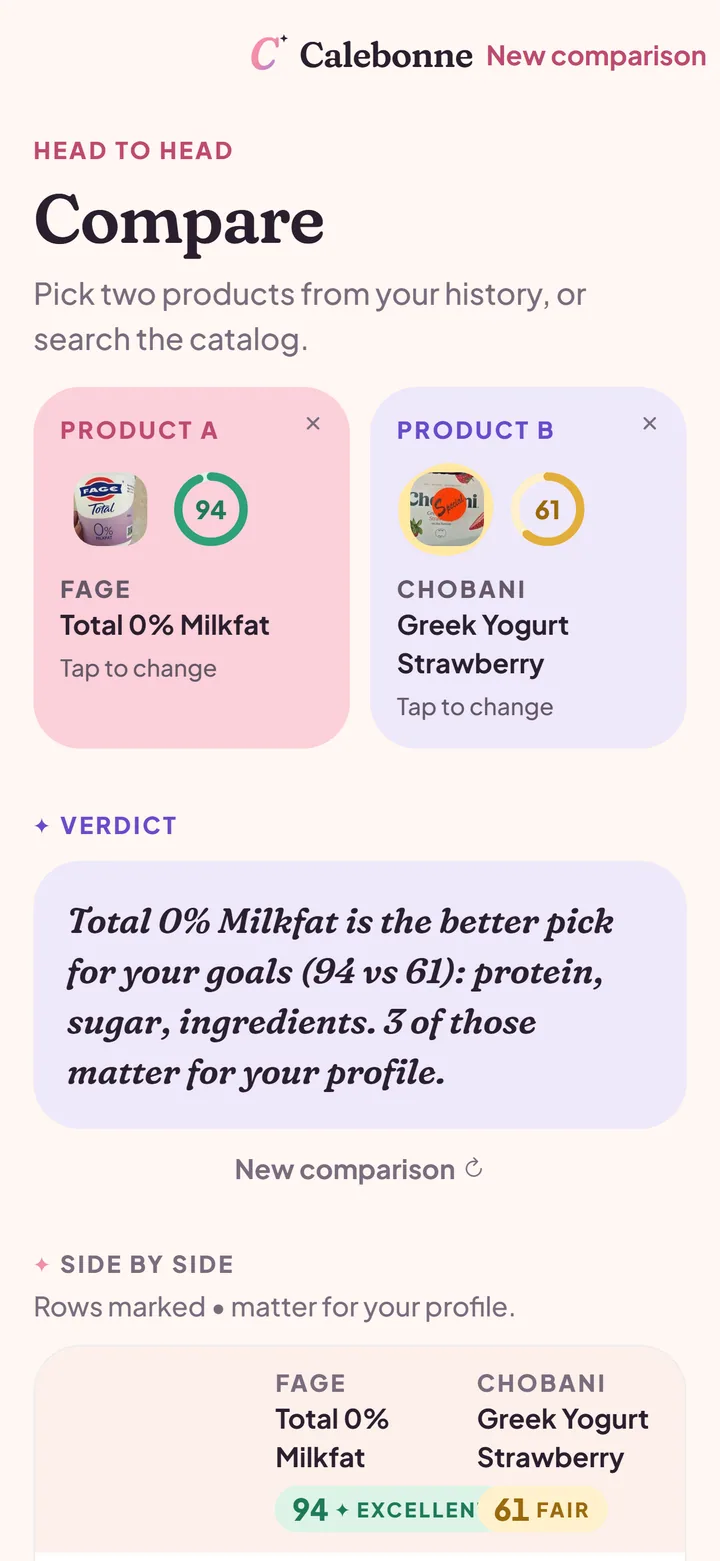
Two products, no idea which one is better? Scan either one. Calebonne turns a barcode or a photo of the label into a clear, evidence-based answer in seconds — a score computed by published rules, not by a chatbot.
iOS 1.0 is with App Review
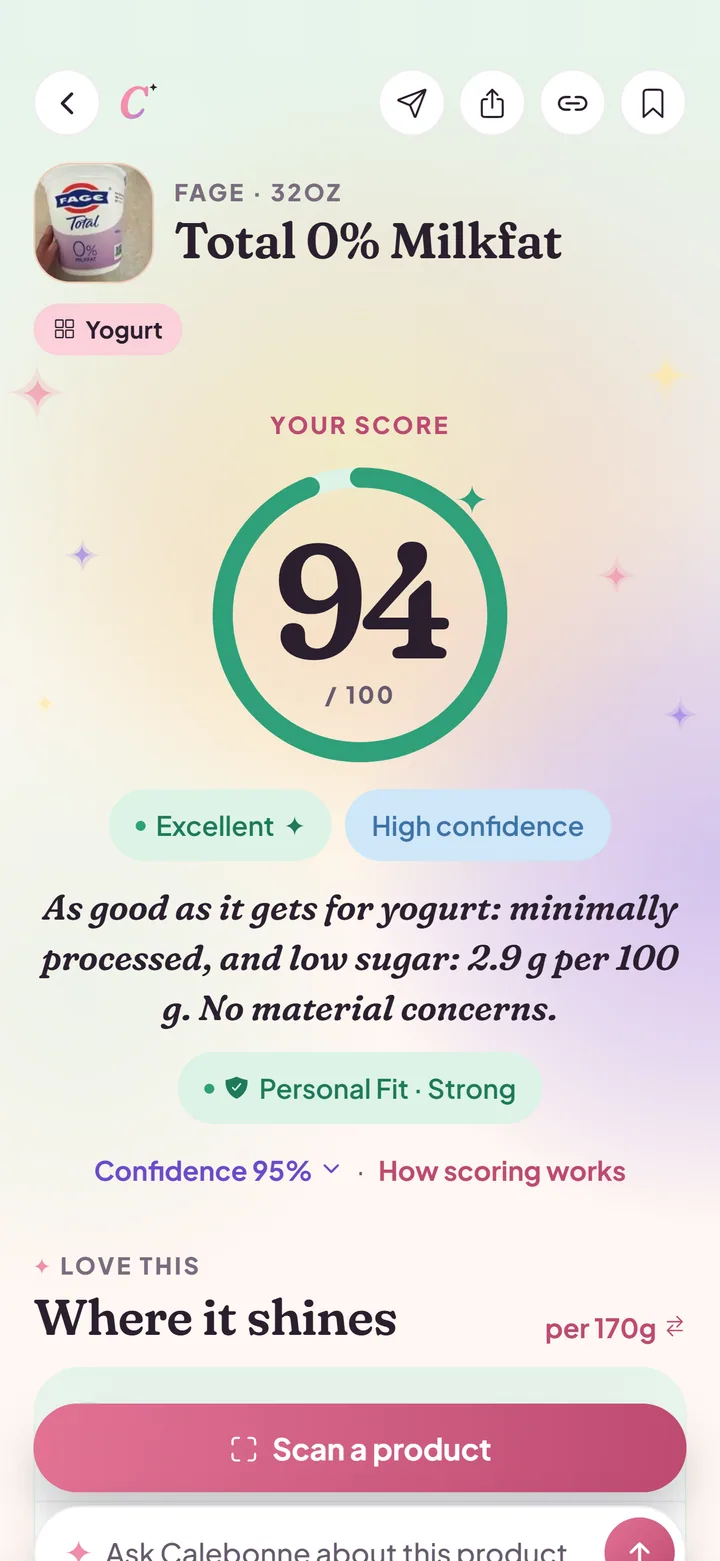
No account needed. Basic safety information is always free.
Three separate outputs
They are never blended. Your goals never move the score, and thin data never gets rounded up to a confident number.
Universal, category-relative, deterministic. A 0–100 rating of a packaged food or personal-care product against realistic alternatives in its own category, computed by a fixed set of published rules from the label.
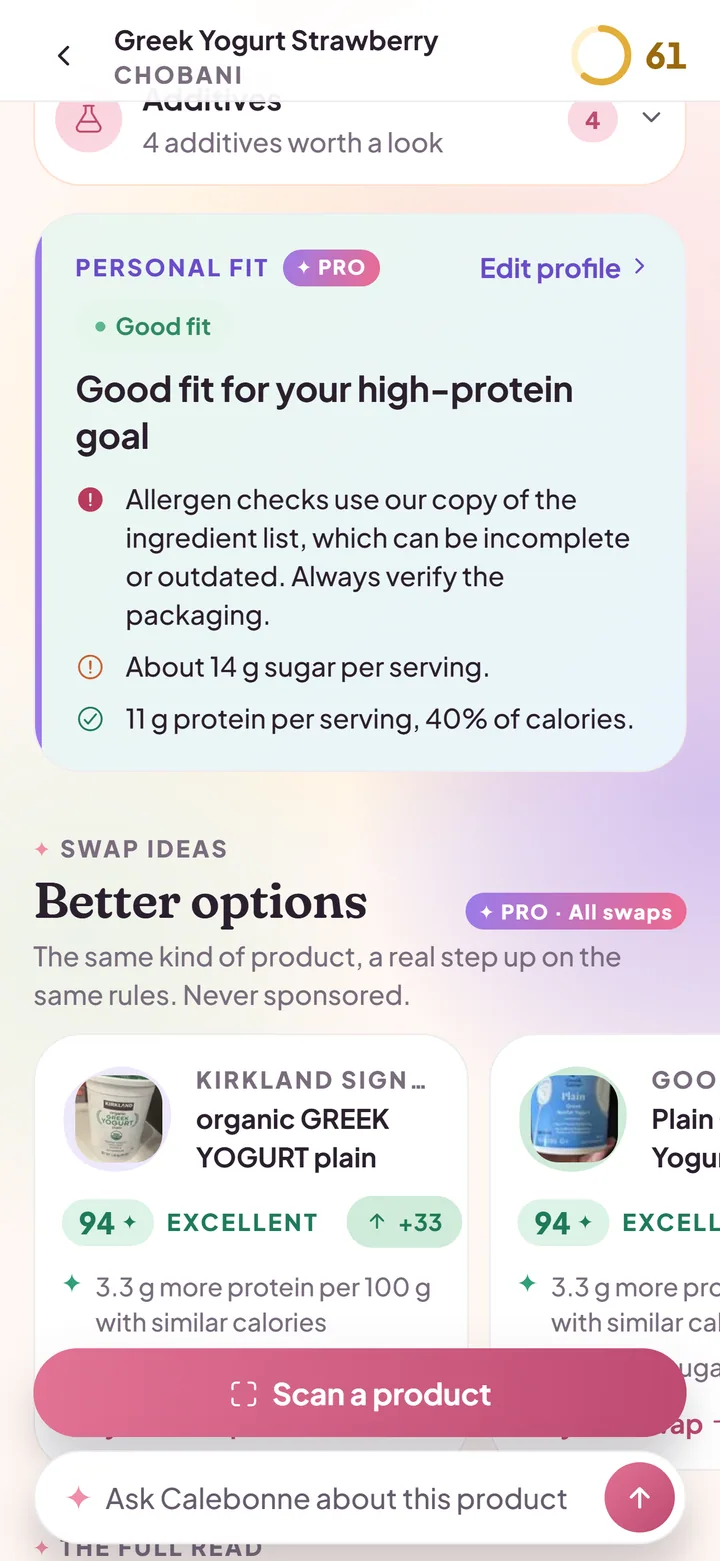
How the product matches the goals, diets, allergens and avoid-list you set. Shown as its own card, in its own tint. It never changes the base score.
How sure we are about the product's identity and label data. Missing or inconsistent data lowers confidence, and when data is too thin we withhold a definitive score rather than guess.
In the app
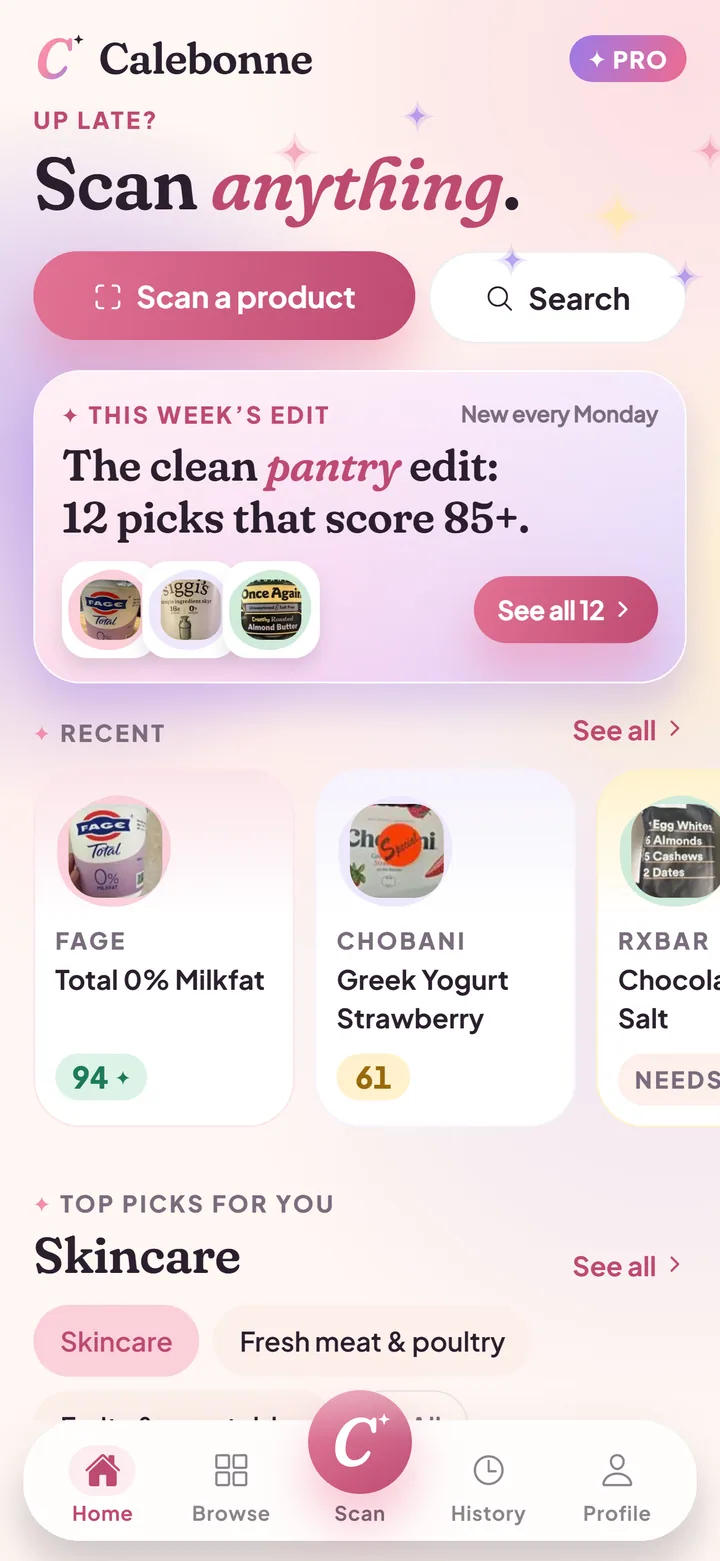
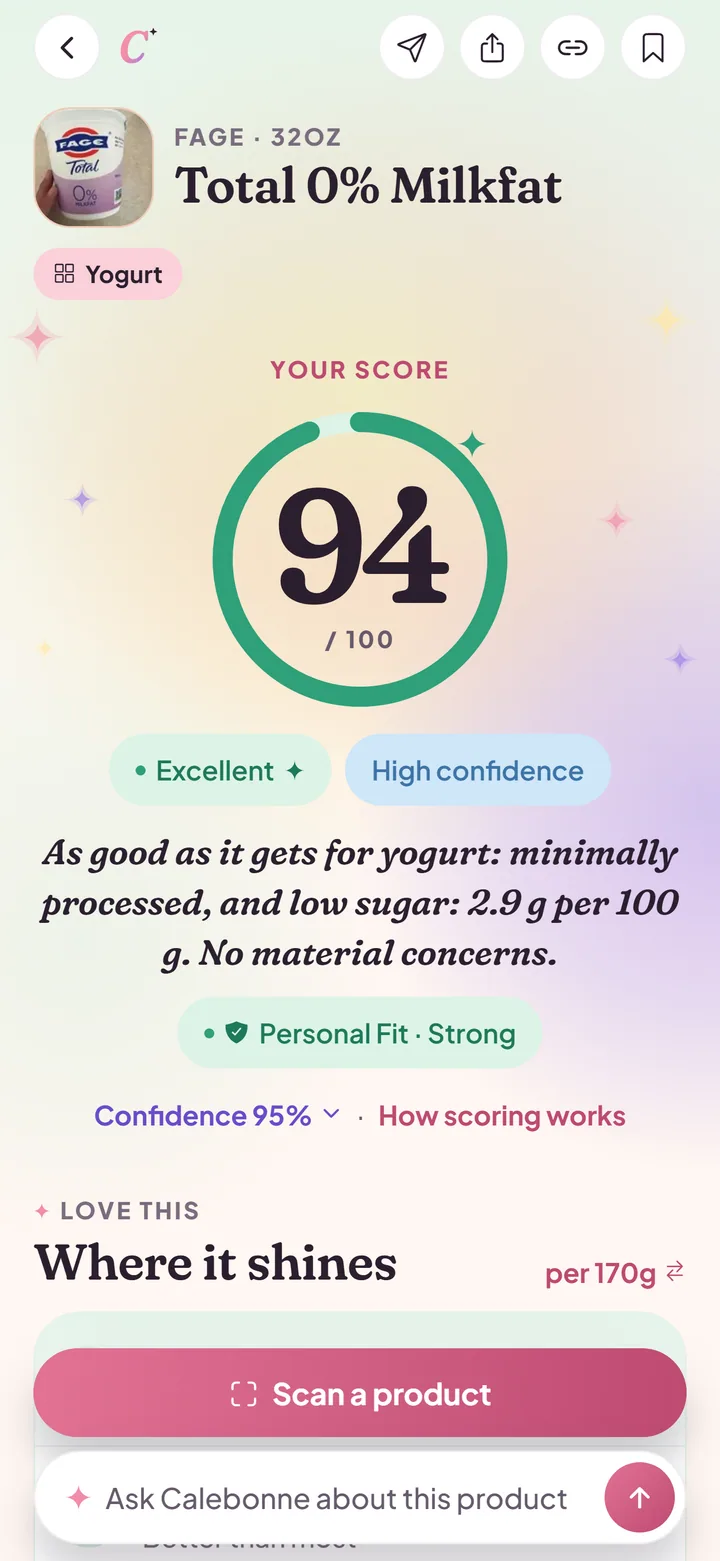
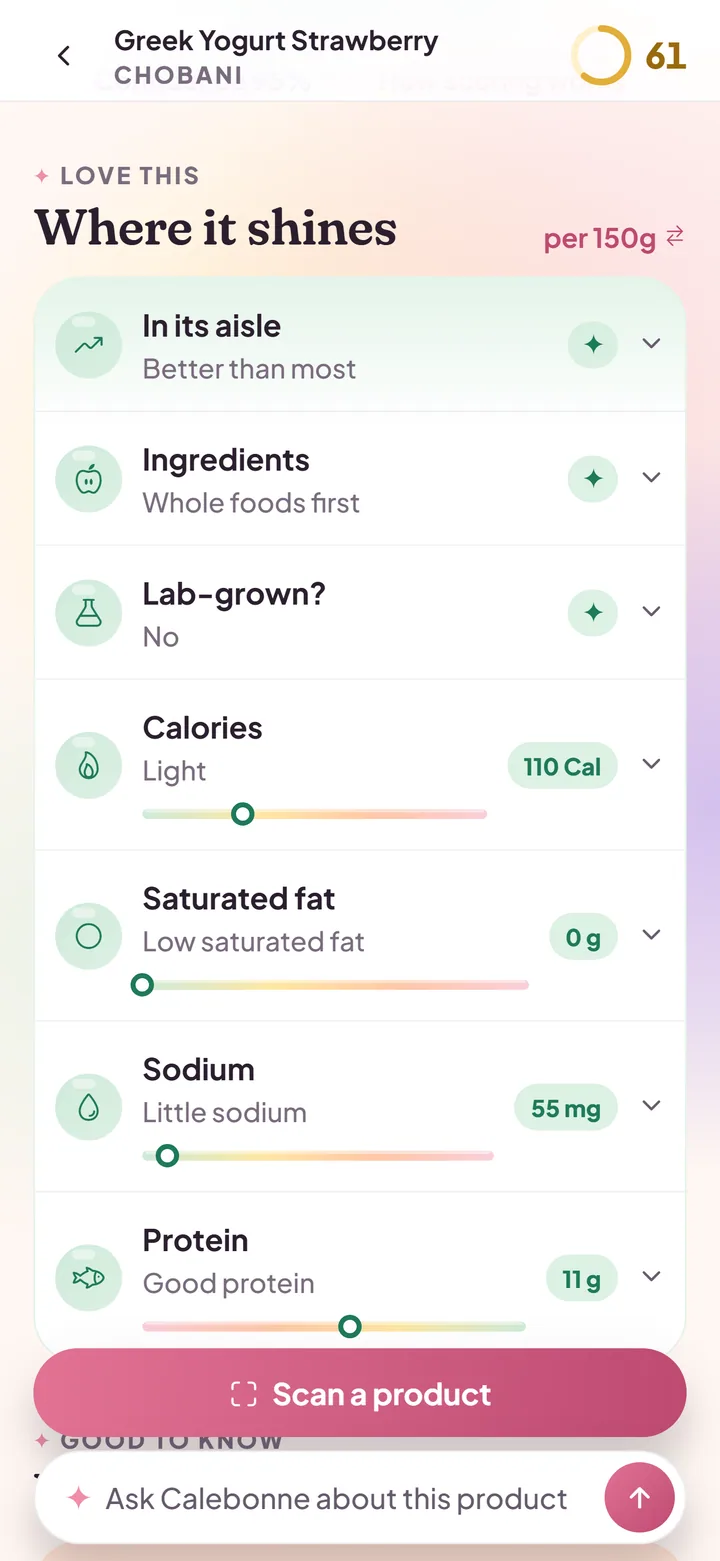
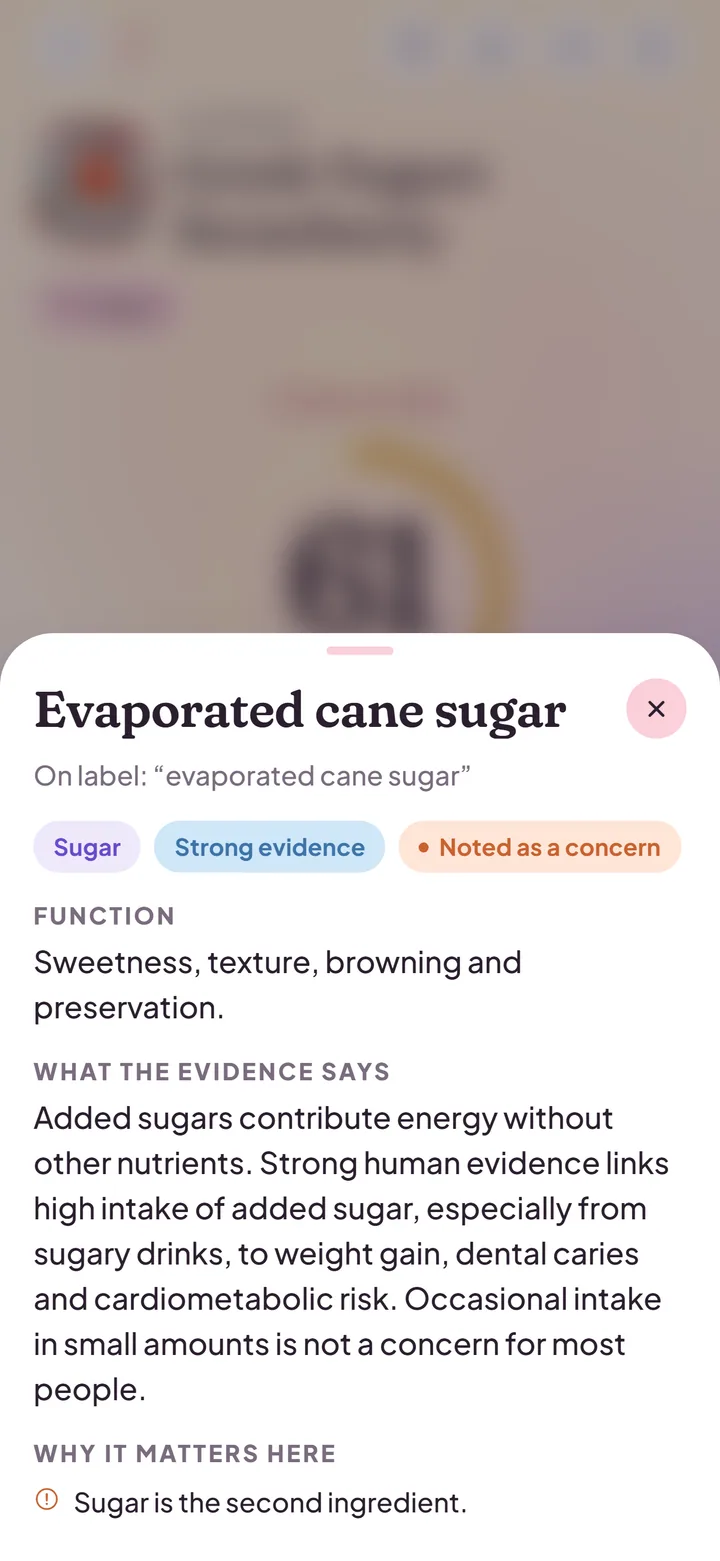
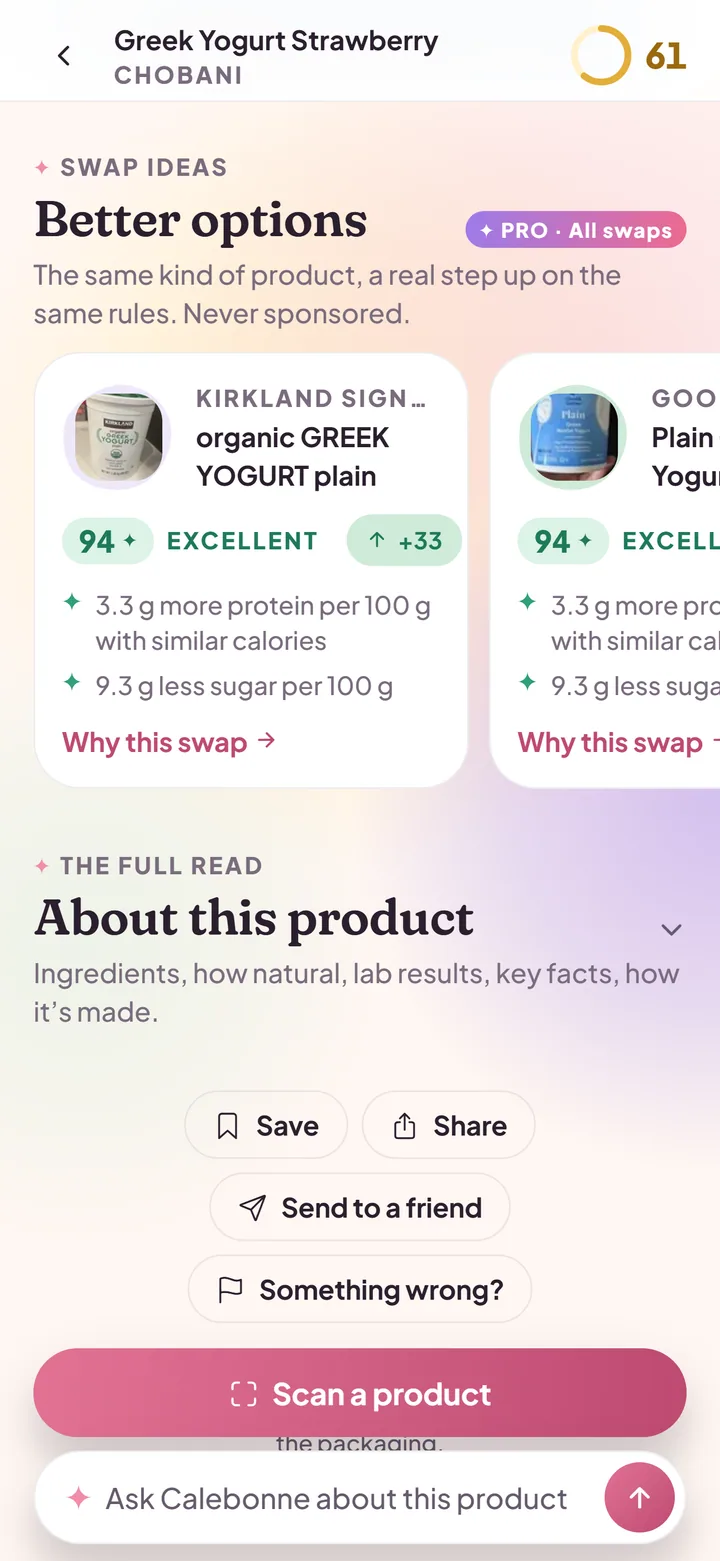
Real screens from the app. Swipe through: scan, score, evidence, fit, swaps and a side-by-side verdict.
Try a score
Six real products. Tap one to see its score and the reasons behind it.
Your score
Pick a product
Tap any card to run the score. The ring sweeps, the band pops, and the top reasons show which rules fired.
Scores come from the live app. Labels change, so always check the packaging.
How it works
The score is computed by versioned, deterministic rules. Language models only extract label data, phrase the reasons and answer grounded questions. No model ever writes a number.
Point the camera at a barcode, or photograph the label when a product isn't on file. No account required.
Five published components — nutrient profile, formulation, processing, category performance, evidence-backed flags — combine with fixed weights. Same label, same score, every time.
Every reason carries a rule ID and an evidence level. Tap an ingredient for what it does, what human evidence says, and how much you'd have to eat for it to matter.
Alternatives from the same category with measurable reasons: "12 g more protein at similar calories", "half the sodium". Never just "healthier".
Evidence, not fear
Each additive on a label resolves to its own profile: a four-level concern tier assigned from human studies, IARC groups and what the EU, the FDA and the US states have actually done, with the concerns in plain words, the evidence level behind them and the sources. Systematic reviews and randomized trials carry the most weight; animal and in-vitro studies are context, never treated as consumer risk on their own.
What it can lead to
What the evidence says
The landmark 2015 mouse study showed it erodes the mucus barrier, and large French cohorts since associate polysorbate intake with heart disease and diabetes. Cohorts cannot prove cause, so the evidence is limited, but the signal is consistent.
Regulation
Approved in both (EFSA group ADI 25 mg/kg, 2015).
Affects the score via
The additive index
The same profiles the app shows when you tap a chip: tier, what it can lead to, the human evidence, the IARC group, what the EU, the FDA and the states did, and the sources. Reviewed October 2026.
Dose matters: these notes describe the evidence at ordinary dietary exposure, not a verdict on one serving. General product information, not medical advice.
Three ways to read a label
Here is how the three apps people already use describe their own methods, next to ours. Nothing here is a claim about anyone's accuracy; it is what each one chooses to measure.
| What it does | Yuka | Bobby Approved | Scout | Calebonne |
|---|---|---|---|---|
| The verdict | 0–100, four bands | Approved or not | 1–100, category-relative, three bands | 0–100, five bands, plus a separate "How natural" meter |
| Nutrition | Nutri-Score, 60% of the score; the same formula for every food | Not scored | Category-relative; NOVA 4 processing caps the score at 70, NOVA 3 at 85 | Scored against the product's own category: a protein bar against protein bars, olive oil against oils |
| Additives | Four risk levels; one high-risk additive caps the score at 49 | Over 100 flagged ingredients; the list is not published | Fixed rules (seed oils always harmful, stevia neutral); no public per-additive tiers | 118 profiled additives with a four-level tier, what each can lead to, the human evidence level, IARC group, and what the EU, FDA and states did. Banned or revoked ones cap at Weak |
| Seed oils, "natural flavors" | Not a criterion | Automatic fail | Seed oils always penalised | Position-graded deductions: a leading seed oil costs more than a trace; flavoring in the top five costs more than at the end |
| Evidence shown | A sources page | A short "why" per ingredient | A methodology page; sources not linked per flag | An evidence grade on every flag, with linked sources, and "limited" means limited |
| Alternatives | Same category, anywhere | Approved products, store lists | Same aisle with prices; every swap is an Amazon affiliate listing | The same kind of product, a real step up, ranked by what your store carries (live inventory where available) |
| Whole foods | Nuts, cheese and butter score on Nutri-Score | Pass if the ingredients pass | Category-relative | Scored as what they are; the "How it's made" card reads the label's claims, including lab-grown |
| Lab results | — | — | Disclosed on the product, not scored | Public third-party findings (heavy metals and more) shown on the exact product, with source and date, never folded into the score |
| Price | Pay what you want for premium | Free, brand-affiliated | Hard paywall after onboarding; about $20 per year after a 3-day trial | Scores, reasons, ingredients and allergen flags free and unlimited; Pro adds fit, swaps and recall watch |
Methods as published by each app on its own help pages and store listings, read in October 2026. Yuka, Bobby Approved and Scout are trademarks of their owners; Calebonne is not affiliated with either.
Score version history
The score version is printed on every product page. When a rule or an additive tier moves, it is listed here with the reason, the same day it ships.
Full rule list with parameters, evidence references and rationale: the methodology endpoint. Brand corrections: support, acknowledged within two business days.
Category-aware
No single formula pretends a granola bar and a soda are the same thing. Each category has its own anchors, and nutrients intrinsic to a category — fat in oils, salt in cheese — are judged where it makes sense.
Terra Nova (sample)
Extra Virgin Olive Oil
vs. cooking oilsMostly unsaturated fat: only 14 g of 100 g fat is saturated. Minimally processed.
Summit Fuel (sample)
Protein Bar
vs. protein barsHigh protein: 19.8 g per serving. Sweetened with an artificial sweetener instead of sugar.
Terra Nova and Summit Fuel are fictional sample products from the Calebonne test set, not real brands. Scores use methodology version food_v1.9.12.
Calebonne Pro
Pro answers the one question that matters at the shelf: is this safe for me. Your goals, diets and avoid list on every scan, unlimited search, every better swap, offline scanning. The score itself never changes.
Basic safety information is always free.
Scores, key reasons, ingredients and allergen flags stay visible on every plan. Pro is about depth, never about hiding what matters.
Free
Pro
or in the app through the App Store · $9.99 / month or $74.99 / year
Billed by Calebonne, LLC through Stripe. Renews automatically until cancelled. Cancel any time: App Store subscriptions in your Apple ID settings, web subscriptions from your receipt email or by emailing support@calebonne.com. No free trial. Your Calebonne account unlocks Pro in the iPhone app.
No pay-to-rank. Ever.
Manufacturers cannot buy a score, a badge or a recommendation. Calebonne is funded by subscriptions.
Rules decide, AI explains.
Every rule has an ID, a rationale, an evidence level and a bounded effect. Changes ship as a new score version with a published diff.
Honest about uncertainty.
If the data is missing or contradictory, Calebonne says so and asks for a label photo instead of guessing. Read the methodology
Questions
No. Calebonne gives general product information. It does not diagnose, treat or prevent any condition and it is not a substitute for a clinician or registered dietitian. A Weak score does not mean you should never eat something; it means better options exist in that category if you are choosing. If you are pregnant, taking medication or managing a diet-sensitive condition, treat Calebonne as general information and consult a qualified professional. Always check the packaging, especially for allergens.
The Calebonne Score is a 0–100 rating of a packaged food (or, for personal care, of the ingredient list) relative to realistic alternatives in its own category. For food, five components are each scored 0–100 and combined with fixed weights: nutrient profile (35%), ingredient formulation (25%), processing (15%), category performance (15%) and evidence-backed flags (10%). Flags with strong human evidence also cap the final score: for example partially hydrogenated oil, sugar-sweetened beverages at 8 g sugar per 100 ml or more, nitrite-cured meat, artificially sweetened drinks and very high sodium. Since food_v1.6 every additive on the label also resolves to its own profile with a four-level concern tier: additives banned or revoked by a major authority cap the score at Weak, and the rest take small, bounded deductions by tier. A separate "How natural" meter (0–100) reads the whole-food share, the additive load, the simplicity of the list and whether anything artificial is present; it sits beside the score and never changes it. The same label data and score version always produce the same score, and the full rule list with parameters is published from the API.
No. We do not accept payment from manufacturers for placement, scores, badges or recommendations, and no sponsorship or affiliate relationship reads into scoring or recommendation code. Manufacturers can report factual errors through the same correction process as everyone else; corrections go to a moderation queue and never overwrite data automatically. If we ever add affiliate links, they will be labelled, and alternatives will still be ranked by score improvement and Personal Fit only.
Calebonne asks you to photograph the label rather than guess. The nutrition panel and ingredient list are extracted from your photo and scored by the same rules. If the data is still missing or contradictory, we show "Not enough verified data yet" instead of a definitive score. We never infer an ingredient quantity the label does not disclose.
No. You can scan, read scores and set your goals without one. Your scan history and profile live on your device by default; we only sync them if you create an account and turn on sync. Calebonne Pro is managed in your Apple ID settings (App Store subscriptions) or, for web subscriptions, from your receipt email or by emailing support@calebonne.com.
The minimum needed to make the product work: the barcodes you scan, the label photos you choose to upload (deleted within 24 hours after extraction unless you opt in to help improve product data), the goals and restrictions you enter, the questions you ask, and basic usage analytics keyed by a random device id. We never sell personal data, never use precise location, and do not show ads. Delete your account and its data in the app at Profile → Account → Delete my account, or email support@calebonne.com for a copy of your data. Read the full privacy policy.


Get launch news, early access and the occasional swap idea. No spam, no selling your address, unsubscribe in one tap.
App Store launch in —